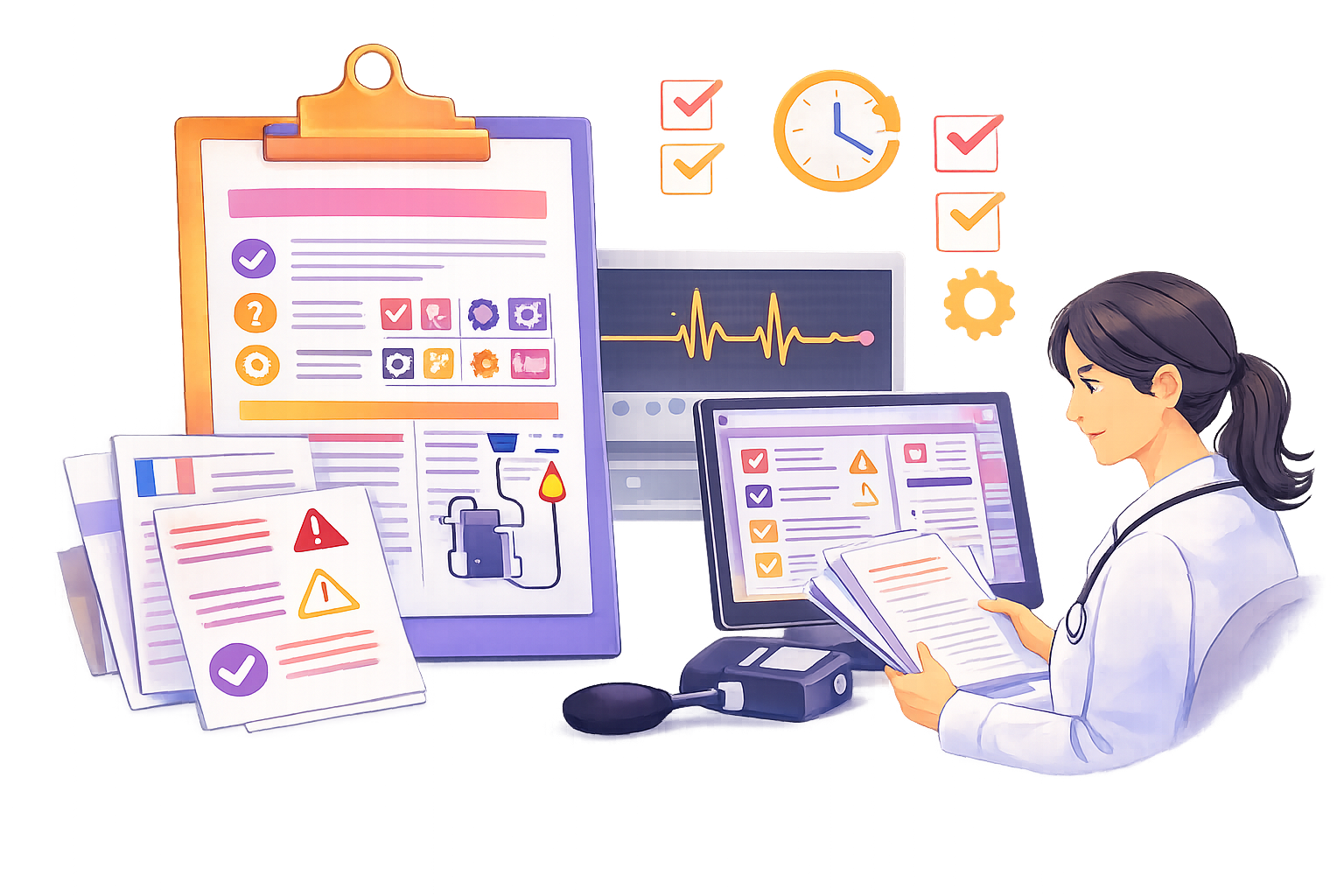
Our Collaborative Review feature enables group work within your DITA CCMS
Are you looking for a way to review all your content in one cycle? Do you have a lot of content that needs to be reviewed before you can publish? Are you looking for an uncomplicated way to schedule all your content reviews? And are you tired of switching between tools?
In regulated industries, change management is a key part of the QMS. To satisfy these requirements, all changes to labeling must have a reason, must be tracked and must be able to be audited.
Our solution, due for release later this year, takes their answers to the issue into account by delivering a unified approach to all the steps in the delivery process, while paying particular attention also to the stringent requirements placed on manufacturers in regulated industries.
The new Componize will offer collaborative reviews, task management, automatic change identification and management, aid with verification and validation cycles, electronic signatures, and much more. All of which conform with regulatory requirements for electronic documentation management and e-signatures, such as 21 CFR Part 11 requirements.
We are convinced that there is an enormous productivity gain to be had in the improvement of this particularly torturous process that has not been sufficiently covered by other CCMS vendors.
Team Silos impact agile delivery
The traditional approach in these industries of keeping silos alive by splitting teams into engineering, systems, software, technical publications and so on means that no matter how agile they try to be, the technical publications team remains the last wagon on a long train. This of course means that that wagon will always be the last to pull into the station.
A collaborative approach to development of the documentation for the device sees this train reduced drastically in length, akin to when double-decker trains were introduced. More passengers arrive at the platform at the same time, while reducing the length of the train. It is still a train, and not all wagons can arrive at the same time, however you are able to deliver more “passengers/features” when the train pulls into the station.
At the end of this article, I hope you will be curious enough to request a demonstration of Componize Concurrent Editing with workflows.
Poll results: Webinar Poll results; LinkedIn Poll results
Componize held a webinar on 10 March 2022 where we played out a scenario with a technical writer sending a draft chapter for review. During the “Pain relief for convoluted review cycles” webinar, we conducted a quick poll.
Of the forty-six attendees, only 3% polled as being able to complete their reviews in one cycle.
Almost half, 43%, however needed a minimum of four cycles.

Using this poll as an example, consider the following scenario:
I send out content for review and approval Monday evening. In the best-case scenarios, I receive the feedback on Tuesday at the end of the day. I then correct the issue on Wednesday and send it out again for confirmation that I have implemented it correctly. 43% of you do this four times, meaning that the document is not finalized until Monday two weeks after I sent out the document.
If I planned a meeting with my SMEs for Wednesday, we could have finalized it in the same meeting. I know where the changes are, I can coordinate the reading of the document, so the SME does not waste their time trying to spot the difference. (Yes, even with a DiffDoc (a red-lined document showing differences), the SME will still wander around the document).
At the end of the meeting, we are all satisfied that the document is complete, and all the feedback has been implemented correctly. I did not have to send intermediate emails to request clarification on a particular piece of feedback. I did not receive conflicting values for table 6 on page 239 from the Image Quality team and the software engineer.
Other issues resolved with this approach
Reason for change
Reasons for change can come from diverse sources. A new feature, a defect, a hotfix, the list goes on. These must be documented in one of the many tools the manufacturer uses to track these events.
Rather than having these listed in some other tool, spreadsheets are a favorite, these can be included in the annotations, comments, and check-in dialogues per topic. A report generated at the end of the project can then list all changes conducted on a document, along with who made them, who reviewed them within the CCMS, and who approved them, again within the CCMS.
Traceability
With the argument put forward above for the reason for change, as everything is being done inside of the CCMS, all actions on all topics are logged in effectively what is a relational database. Users have unique IDs to connect to the CCMS, as such any changes are logged under their names.
Organizations that use SSO (Single Sign-On) to access their tools already have the confidence and are already qualified for use under their QMS (Quality Management System) that users are unique and that signatures cannot be counterfeited. Applied correctly, SSO authentication that meet 21 CFR Part 11 requirements can rest assured that any reports generated under such a system are audit ready and can be trusted for authenticity.
Auditability
This brings me on to auditability.
Manufacturers subject to regulatory audit are usually those slowest to adopt changes to “traditional” approaches to converting paper processes to digital ones. The reason given for continuing to “print” documents for analogic signature for approval is built on the old concept that PDFs are non-modifiable.
While this was true in the early 2000s, the profusion of free PDF editing tools means that argument holds less water in 2022. On the other hand, CCMS and other content management systems have become more robust. The ability to track all changes to a document, create snapshots of the source data and be able to reproduce the exact same content as and when required means that manufacturers should now start looking at using the full capabilities of their systems. These manufacturers have spent a lot of time and resources qualifying their systems and include them in their QMS strategy.
Reporting
The ability of an auditor to receive accurate results when they examine the design history of a device is crucial to receiving a clean bill of health. A successful audit depends on the auditor’s skills and the company’s well-kept records, transparency of its operational reporting, and in the case of publications destined for use or maintenance, if the organization can provide clear and detailed history of changes to the publications, ideally with directly traceable links to the reasons for change.
SME engagement in the review process
Our goal at Componize is to continually improve our tools to improve content creation lifecycles. As a stop-gap solution to our new product, Componize CCMS integrates oXygen Web Author with a Collaborative Editing feature. This plugin is a further step to providing a collaborative content management system that allows for traceability and auditability.
Using this feature, authors can set up meetings where they are able to work in real time with their SME to finalize the document. SMEs can edit the document with the author present, with each being able to either add annotations, or change the source content.
Using Componize with its fully customizable workflows means that you can set up your content production. It also has a built-in review cycle that completes in one cycle. This means that the CCMS can help regulated industries to comply with regulations by providing them with an effortless way to track changes made to their content, as well as who made those changes.
The review interface is customizable to remove XML tags, so they see what looks like a final rendered version of the topics. The tool bar is simplified leaving only the tools required for review apparent, resulting in a very shallow learning curve.
For one of our customers, Componize was able to implement a full cycle review process including both our concurrent editing feature and customized workflows spanning the entire documentation life cycle. The feedback was phenomenal. While we have not yet conducted a survey of improvements, the feature is still brand new, the technical writers and project managers have expressed appreciation for the reduction in inutile draft publication, repeated emails to complete reviews of a topic, and having to remember the necessary order of steps to follow for approving a document before publication.
Description of a refined process
With Componize:
- Design your workflow(s)
Componize workflows can:
– Set document status (ready for review, reviewed, review edits, approved…)
– Move documents along the document lifecycle
– Set permissions for distinct roles (read only, edit allowed by role x, full access …) - Deploy the Concurrent Editing plug-in and set it up to suit your workflows
- Deploy electronic signature plugin if you want to include electronic signatures using SSO
- Start reviewing in shorter cycles
Find out more about Componize Workflows feature in our dedicated page to Content Lifecycle Management
Results
A fluid, customizable workflow that guides the user base through the document lifecycle. A simplified interface for SMEs to conduct reviews. A CCMS that tracks all changes within the document and can provide trace reports of who did what, when and why. All backed up with a best-in-class database that conforms with regulatory requirements able to provide audit reports.
Watch a short video on using Concurrent editing on our YouTube Channel.