Introduction
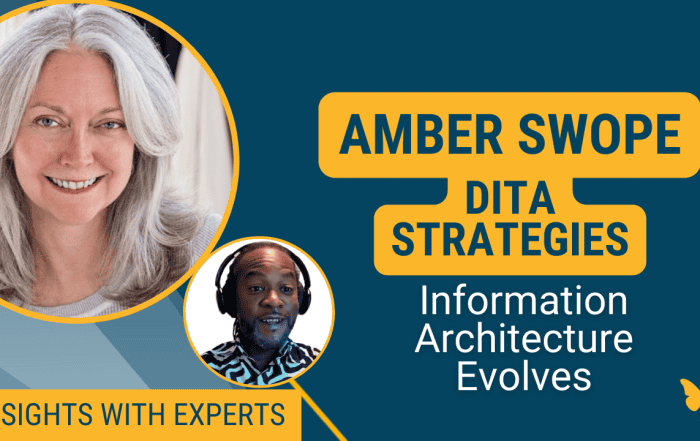
Information Architecture Evolves! In this episode of Componize’ “Insights with Experts” video series, I had the pleasure of interviewing Amber Swope, an expert in the field of DITA strategies. Amber shared her expertise on a range of topics related to Information Architecture, metadata, and taxonomy.
What is Information Architecture?
Amber “The definition that I particularly like is Information Architecture is the art and science of organizing information so that it’s findable, manageable and useful”.
People have limited attention spans and working memory, and are more likely to remember information that is presented in a clear and organized manner.
We need information architecture and architects to help us organize, make sense and find a needle in an ever increasing range of media type haystacks.
One cognitive theory linked to IA, “Information Processing Theory”, posits that people process information in a systematic way, and that their ability to do so is limited by the amount of cognitive resources they have available. Information Architects, amongst others, can use this to guide the design of effective information architecture dependent on the target user base.
Information Architecture Evolves
A common mistake by organizations is thinking that their work is done once they have implemented their information architecture. Information architecture is an ongoing process that must continually evolve over time. Organizations grow and their needs change, as such your information architecture must evolve with the organization, or otherwise risk getting stale, and no longer useful or relevant to the organization.
Amber emphasizes the importance of regularly evaluating and updating Information Architecture to ensure it continues to meet the needs of the organization. It is vital to have a clear and well-defined governance plan for your information architecture, ensuring it remains effective over time.
Amber also suggests organizations should avoid the trap of thinking that once the Information Architecture in place, it will continue to deliver on its content structure goals.
Align Information Architecture with business goals
Amber spoke about the importance of aligning your information architecture with your business goals and objectives, to ensure it supports your organization’s overall strategy.
As your organization grows, your business goals evolve to satisfy that demand. Leaving your IA at the level it was when it was developed means that it can no longer fully serve its purpose of making information available, at the right level for the right user.
Differences in Information Architecture maturity models
At the basic level, an IA model version one can be set to answer the question, is my DITA file valid?
The next level up is at the map level. Chunking content units by type, tasks, concepts etc. This allows you to build knowledge by type. For example, a user knows to find the definition of terms, they can consult the glossary chunk.
From that is grouping the different types of content units by purpose. For example, installation tasks are grouped and sequenced in a logical order, and uninstallation types are also grouped and placed in a location that is logical for the user to find, say towards the end of the “linear” manual.
And some companies get away with that model for ages. However, for the model to remain effective, it needs to mature and cover different business objectives.
The Importance of Metadata and Taxonomy
One of the most frequent questions that Amber receives from her clients is about reuse mechanisms. The answer relies heavily on metadata and particularly using that to build and maintain a taxonomy that will then guide your reuse strategies.
What is metadata. It’s data about your data, or information about the thing. The thing in our world of DITA structured writing is the ditamap or the DITA topic.
A well-defined metadata strategy, drives your taxonomy which in turn helps you classify, and your users find the information they need.
When it comes to developing an effective information architecture, metadata and taxonomy are two of the most important concepts to understand. Metadata is what helps users find the information they need, and having a well-defined metadata strategy is crucial to the success of your information architecture. Similarly, taxonomy is what helps to classify and organize information in a way that makes sense to users. Without a clear and well-defined taxonomy, your information architecture may be confusing and difficult for users to navigate.
Amber also shared some of the common pitfalls that organizations can fall into when it comes to metadata and taxonomy, for example, creating metadata fields can lead to confusion and inconsistency, advice which obviously also applies to taxonomies making it hard for users to find the information they need.
And ontology?
Quite simply in our context, ontology is description of the relationships between the categories of taxonomy.
Do I need taxonomy?
Many a time when asked, do I need taxonomy, my company doesn’t have one, the truth is in fact that all organizations that distribute content have some form of taxonomy or the other. Amber Swope “I can guarantee that your organization not only has a taxonomy, you have multiple taxonomies, they just are probably sitting on some server that you don’t know about.”
If you reflect on it, your marketing department uses it to class products and product variant/versions, your webmaster or the department that handles web distribution has one. How do you know? Well because they are able to filter and find information required when they need it. The biggest challenge is finding the person or department who owns the taxonomy.
Metadata has a role on user experience
So you’ve written your product help, used the right information typing categories, chunked it appropriately, it’s the right size and is completely accurate, if you don’t provide a way for users to easily access that information at the time they need it, you might as well not have written it.
And how does one find information at the right moment, just when they need it? You search for it. Amber, “… this is where, website analytics are fascinating. Go and see how much of your information is never read, and then try to figure out why. It’s usually because people do not know what’s there, and there’s no easy way for them to get to it. How do you build that easy way to get to it? Metadata, metadata, metadata metadata.”
Communication and Collaboration
Amber also mentioned the importance of communication and collaboration when developing an information architecture. It’s important for everyone involved in the process to be on the same page and to have a shared understanding of the goals and objectives of the project. There is a need for open and honest communication throughout the process, to avoid misunderstandings and ensure that everyone is working towards the same goals.
An example of where communication failure can be drastic, is in the case of a company that has made many acquisitions. The word “product” might not mean the same in one entity as it does in the other. And with that misunderstanding not cleared up through meaningful communication and collaboration, the content delivery platform could so easily exclude all the products from entity A, as it has not been tagged “correctly”.
“It’s like you and I are going into a conversation. And us not agreeing on that which language we’re going to speak. We’re talking, but we don’t understand each other. And that’s exactly what happens if your metadata isn’t aligned.”
Try this at home: How many ways can you define the term “Component”?
How can a CCMS help improve metadata management?
A CCMS can help improve metadata management by making taxonomy values easy to apply to content units or inject them directly into the said content units. As the maturity of your taxonomy evolves, additional values can be easily applied without the need to check out a topic, an issue that is very onerous for organizations in regulated industries. This has a positive impact on your content lifecycle by avoiding unnecessary content changes.
Using the CCMS, publication validation can be performed to ensure that all necessary values are present when generating content packages, to ensure that the right content for the right target is available when required by the end user.
A very powerful feature every CCMS should have is an ability to inject metadata directly into XML files, but also to be able to apply it to the content units as well. This can come in particularly useful when major changes to your taxonomy are required, or you are importing a large quantity of new information. Along with injection of course comes extraction of metadata from the repository.
Another powerful feature to search for, is an ability to connect to taxonomy and terminology management tools.
As your Information Architecture evolves, you will find it harder to manage it manually. Better off opting for a tool that will evolve with your organization.
Conclusion
Information Architecture evolves, and so it should. Once upon a time, shipping containers were just metal boxes. But now, they’re incredibly smart units that can track everything from what’s inside them to where they’ve been and who owns them. In fact, they’re so smart that you can tap into a shipping container and get all this information with ease.
This is metadata in action. Why not apply it to your content too? Transform your “dumb” content into super smart content that “speaks” to the user.
If you’re looking to stay ahead of the curve in this rapidly-evolving field, be sure to check out the full “Insights with Experts” video featuring Amber Swope.
Find out more about Amber Swope and DITA Strategies.
Related Componize Blog Posts
- Kaplan’s Successful CCMS Migration to Componize CCMS
- Read more Componize articles in our blog page
- Head over to our YouTube Channel for our Insights with Experts interviews and discussions with leading industry experts on all aspects of technical communication