Introduction
In manufacturing, technical documentation is as critical to success as the products themselves. Whether in aerospace, automotive, industrial machinery, or medical devices, accurate and up-to-date documentation ensures product quality, regulatory compliance, and customer satisfaction.
However, as products become more complex, regulatory requirements more stringent, and markets more competitive, keeping documentation complete, accessible, and reliable over decades has become a major challenge. Teams often battle fragmented content, outdated formats, compliance headaches, and inefficient processes that drain resources and slow down time-to-market.
The solution lies in a principle that is often overlooked but has the power to transform documentation into a strategic asset: Digital Continuity. This is the ability to preserve and maintain the integrity, accessibility, and usability of product data and documentation throughout the entire product lifecycle, from design to end-of-life, regardless of technological or organizational changes.
In this article, we will explore:
- What Digital Continuity means for manufacturing documentation
- Why it is critical in today’s manufacturing landscape
- The challenges it solves
- How manufacturers can achieve it with the right approach and technology
What Is Digital Continuity?
According to Wikipedia, digital continuity is “the ability to maintain the digital information of a content creator in such a way that the information will continue to be available, as needed, despite changes in digital technology.”
In the context of manufacturing documentation, this goes beyond simply storing data. Digital continuity preserves not only the content but also its context, including metadata, structure, relationships between components, and version history, ensuring that documentation remains usable and trustworthy over decades.
For manufacturers, this is particularly important because:
- Products often have lifecycles of 10, 20, or even 30 years.
- Regulatory requirements demand traceability and compliance over long periods.
- Technology changes rapidly, risking format obsolescence or vendor lock-in.
Digital continuity is not just about avoiding data loss, it is about safeguarding the value embedded in your documentation so it can be leveraged for operational efficiency, compliance, and innovation.
Why Digital Continuity matters now
Manufacturers are facing a perfect storm of challenges:
- Shorter time-to-market pressures combined with increasingly complex products
- Global collaboration across teams, suppliers, and partners
- Diverse content formats ranging from CAD files and XML to PDFs and videos
- Stringent compliance demands that vary across regions and evolve over time
Without a strategy for digital continuity, organizations risk:
- Losing access to legacy documentation during system migrations
- Spending excessive time searching for or recreating information
- Facing compliance penalties due to missing or inconsistent records
- Getting trapped in expensive, inflexible vendor contracts
With digital continuity, manufacturers can:
- Maintain a single source of truth for all documentation
- Ensure regulatory readiness at all times
- Enable faster, more coordinated collaboration
- Preserve operational agility over decades
The challenges digital continuity solves
1. Elimination of silos
Content silos are one of the most common and damaging problems in manufacturing documentation. Different departments or regions often manage their own repositories, resulting in duplicated or conflicting information.
It is important to note that departments often do not really have a choice. While in some cases they may rely on specific solutions for the wrong reasons (holding on to information is a way of holding on to power), most of the time it is because their data can only be created and managed through specialized tools.
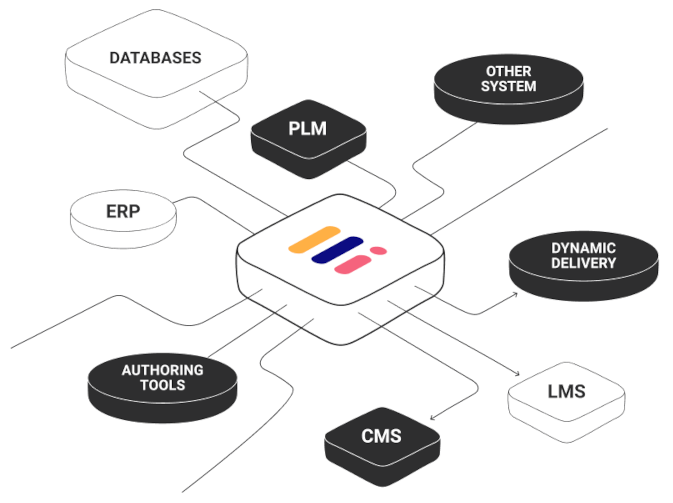
At Componize, we are fully aware of this reality: it is impossible to concentrate the production and management of all data and information into a single solution. That is why we focus on providing an open architecture, with well-documented APIs, and why we constantly work on solutions to import data from third-party systems or to export documentation wherever it is needed.
With digital continuity, content can be integrated from multiple sources into a centralized system while preserving its structure and relationships. This ensures everyone is working from the same, authoritative version, reducing errors, saving time, and enabling better decision-making.
Example from the field: Toyota Motor Europe integrated Componize CCMS with its centralized data hub, automating the retrieval of up-to-date technical information for service bulletins and eliminating the need for manual copy-paste.
2. Risk mitigation
System migrations, software obsolescence, and vendor changes can jeopardize the accessibility of critical content. Proprietary formats make this risk even greater.
Digital continuity mitigates these risks by:
- Using open standards like DITA XML for long-term portability
- Ensuring content remains usable regardless of the tool used
- Preserving complete version histories for traceability
Example from the field: A global life sciences company used Componize CCMS to retrieve and update a user manual for a product delivered 12 years earlier, ensuring it reflected current branding and regulatory requirements within minutes.
3. Process improvement
Disconnected systems and manual workflows slow down the creation, review, and delivery of documentation. Digital continuity supports streamlined, automated workflows that connect all stakeholders and keep documentation aligned with product changes.
Example from the field: A leading medical devices manufacturer achieved consistent, compliant content across multiple markets by updating legal and regulatory content in one place and automatically propagating changes across all document versions.
4. Long-term support
For industries like aerospace or medical devices, documentation must be maintained for decades, often long after the original tools have been retired.
Digital continuity ensures that:
- Content remains readable and editable long-term
- Regulatory archives remain complete and accessible
- Updates can be made without starting from scratch
Example from the field: A hospital requested updated documentation for a product over a decade after delivery. Thanks to structured content in Componize CCMS, the manufacturer provided a compliant, up-to-date manual almost instantly.
5. No vendor lock-in
Proprietary documentation systems can trap organizations, making migrations costly and risky. Digital continuity based on open, portable formats ensures freedom to change tools without losing content quality or accessibility.
How to achieve digital continuity
Achieving true digital continuity requires more than good intentions. It demands a strategic framework supported by the right technology and practices.
Key pillars:
- Structured Content with Open Standards
Adopt formats like DITA XML to ensure portability and reusability. - Component Content Management System (CCMS)
Use a CCMS to manage content at the component level, ensuring consistency, reuse, and traceability. - Integration with Existing Systems
Connect the CCMS to PLM, ERP, and other enterprise systems to eliminate manual copy-paste and keep data synchronized. - Automation
Implement rule-based workflows, automated transformations, and content validation to reduce manual effort and errors. - Lifecycle Strategy
Plan for the entire product lifecycle, ensuring documentation is future-proof against organizational and technological changes.
Conclusion
Digital continuity is not a luxury, it is a necessity for modern manufacturing. It safeguards the accuracy, accessibility, and usability of documentation over decades, empowering manufacturers to operate more efficiently, reduce compliance risks, and remain agile in the face of change.
By adopting structured content, an open-standard CCMS, and automation, manufacturers can ensure their documentation is a long-term asset, not a liability. Companies like Toyota Motor Europe, Airbus, and leading medical device manufacturers have already proven that with the right approach, digital continuity can deliver measurable business value, including cost savings, faster time-to-market, and improved compliance.
For manufacturers ready to take control of their documentation future, digital continuity is the foundation.
From theory to results
Discover how leading manufacturers overcome documentation challenges with Digital Continuity, and how you can too. Get practical insights in our full white paper on our dedicated page.