Subject Matter Expert (SME) roles in the technical documentation process has changed dramatically over the past few years. This change is in part due to the rise of Content Management Systems (CMS), and specifically Component Content Management Systems (CCMS).
Our study of the technical writing market yielded valuable insights, which we decided to turn into a blog series. We carried out this study to highlight and strengthen our observations about the changing nature of content authoring markets over recent years.
Question: At what stage, and to what degree are SMEs now involved in the documentation review process, and how has the introduction of structured content authoring, which differs from the linear content creation of Microsoft Word or Google Docs, changed the writer/MSE collaboration?
While structured authoring tools such as Adobe FrameMaker have been available for years, only recently has DITA with the use of light-weight editors made the interface to viewing this structured content more user friendly. Previously these tools required extensive training before they could be used effectively; now however they can be utilized by writers and SMEs who may not have any previous experience using them.
The shift from linear style content creation to structured content authoring tools has led to an increased level of collaboration between writers and SMEs during the writing phases of pre-production (planning), and post production (documentation review).
Read our article on the Evolution of technical writing.
Who responded to the survey?
The survey reached out to actors in the technical writing market from all over the world.
The survey focused on content specialists who are involved with creating, managing and writing content for an organization’s website or digital properties (such as apps).
The first question we asked people was about the content strategy and type of solution used by their organization to produce technical documentation. We wanted to be able to break our respondents into two ‘tracks’- those who use a structured or semi-structured content strategy (using solutions such as a Help Authoring Tool (HAT), a DITA CCMS, an XML CMS or a Wiki) and those who use an unstructured content strategy (word processors). This would help us to differentiate the challenges faced by our respondents.
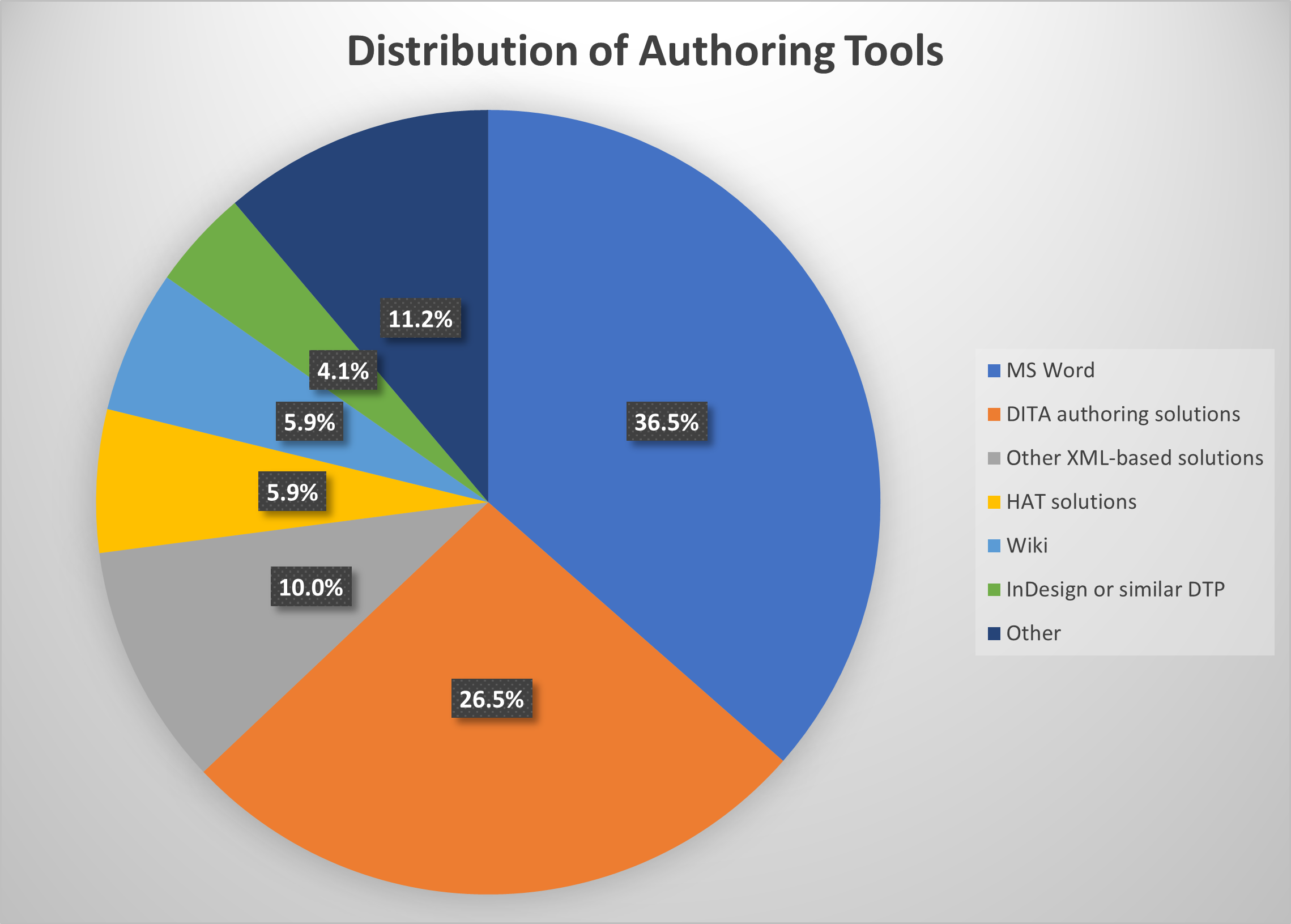
We found that MS Word, or other word processors, are still commonly used by our survey respondents – with 36.5%. DITA authoring solutions (26.5%) and other XML-based solutions (10%) collectively formed exactly the same percentage, followed by HAT solutions (5.9%), a Wiki (5.9%), an InDesign or similar (4.1%) and ‘other’ (11.2%). This means that 62% of respondents fit into our ‘Structured Documentation’ track, whilst 36.5% are in the ‘Unstructured Documentation’ track.
It was interesting to see how different the responses were when we directed our survey only at LinkedIn members who identified themselves as “technical writers“—compared to when we pushed it out via email blast and social media among other DITA industry contacts.
Even when we were targeting only technical writers through LinkedIn, 30% of those who responded used some form of XML-based CMS (DITA or otherwise) and only 42% relied on Word.
This suggests that, for writing technical documentation, the use of XML solutions has intensified in recent years.
A question we often get from our customers is “What role should SMEs play in a CCMS?”
This question comes up because the traditional role of SMEs is to perform the final review and validation of content, which makes them critical to any CCMS implementation. But there’s more that can be done with your SMEs than just reviewing and validating content. In fact, they can play an important part in every stage of the content lifecycle: draft, review, and validation.
How important are subject matter experts in the technical documentation process?
We then asked technical writers about their views of Subject Matter Experts’ (SMEs) importance in the technical documentation process, and the results showed us that they are more than just important. In fact, 92% of technical writers feel that SMEs are vital (67%) or very useful (25%) in the process of creating documentation. We weren’t surprised by these results, but the statistics do allow us to raise the following points for debate:
- SMEs are crucial in the production of documentation, so it’s important that we ensure our tools and processes support their needs.
- Can the process of collecting information or feedback from SMEs at each stage of a project be made more efficient?
To gain a better understanding of what goes into the author and review processes, we wanted to know exactly what SMEs do.
More than three-quarters of respondents said that SMEs validate content before it is published (75%), suggest changes to existing content (74%) and carry out technical reviews of new or updated content (72%).
Surprisingly, more than 40% of technical writers said that SMEs actually create original content themselves.
How satisfied are writers with their current review solutions?
Survey results show that writers are not satisfied with the current review solutions. In fact, they don’t believe they are getting enough feedback from subject matter experts (SME). They also want to see more SME involvement in the review process. It’s clear that there is a significant disconnect between what subject matter experts need and the tools available to them.
We used the “Net Promoter Score” (NPS), a type of customer survey question, to ask respondents if they would recommend their current CCMS review process to others. Respondents who use a structured documentation solution are not overly satisfied with their review process. However, there was a significant difference between those who told us that SMEs do review content directly through the solution and those who don’t.
When SMEs review content through the solution, the number of ‘promoters’ increases by more than 75%, whilst those who become detractors are reduced to a quarter.
Satisfaction is clearly higher when SMEs review content directly through the solution, but despite this, the NPS is still -9.8. This means that the percentage of detractors is higher than the percentage of promoters.
Why don’t organizations use their CCMS for subject matter expert reviews?

What roles does a subject matter expert play in the documentation process?
Contrast the previous question with the importance of the role an SME plays in the documentation process.

From the results gathered from these two questions, it became clear to us that there is a real and statistically significant correlation between SMEs’ direct interaction with the documentation solution and the efficacy of the review process.
One of the main advantages of CCMS is that it clearly improves collaboration between author and subject matter expert during the review process.
One of the main advantages of CCMS is that it clearly improves collaboration between authors and SMEs during the review process. When using traditional CMSs, there are usually two phases: editorial and technical. Authors submit their work to a reviewer who then makes modifications based on feedback from other reviewers or the SME. The result is that authors spend a long time waiting for their changes to be reviewed, which slows down the entire process and increases costs.
In contrast, CCMS allows authors to keep working while their document is being reviewed by allowing them to see comments in real time as they’re made—something that wasn’t possible with previous systems (which required you to wait until all reviews were completed before making any alterations). This reduces errors in documentation while also helping teams work more efficiently together by increasing collaboration between SMEs and writers throughout each phase
Survey results
The survey results were analyzed in the following ways:
- By country (United States, United Kingdom, France, Germany…)
- By company size: large companies (>1000 employees), small-to-medium companies (100 to 999 employees), and one person businesses. The largest group was large companies.
- By type of company: consulting/technology vendor or service provider.
- Consulting/technology vendors are those who develop CCMS software and sell it as a product to other organizations;
- service providers provide services related to CCMS but do not develop content management systems themselves.
The largest group was consulting/technology vendors with 55% of respondents representing this category; only 17% represented service providers.
- By industry: industries included publishing & media, education & training, travel & tourism and healthcare & pharmaceuticals.
- By sector: sectors included private sector/public sector
Conclusion
With the rise of content management systems and in particular the component content management system (CCMS), SME involvement in the review and validation process has become more complicated. At what stage, and to what degree are SMEs now involved in the documentation review process, and how has the introduction of structured content authoring, which differs from the linear content creation of Microsoft Word or Google Docs, changed the writer/MSE collaboration? The answer to these questions depends on how the CCMS is implemented. A poorly designed and implemented system can result in a complete loss of SME involvement and a reduction in quality, but well-designed systems can help reduce the burden on the SME by streamlining processes and enabling greater collaboration between SMEs and content authors.
Related Componize Blog Posts
- Collaborative real-time reviews and editing for Technical Documentation
- Regulated industries: stop the review process nightmares